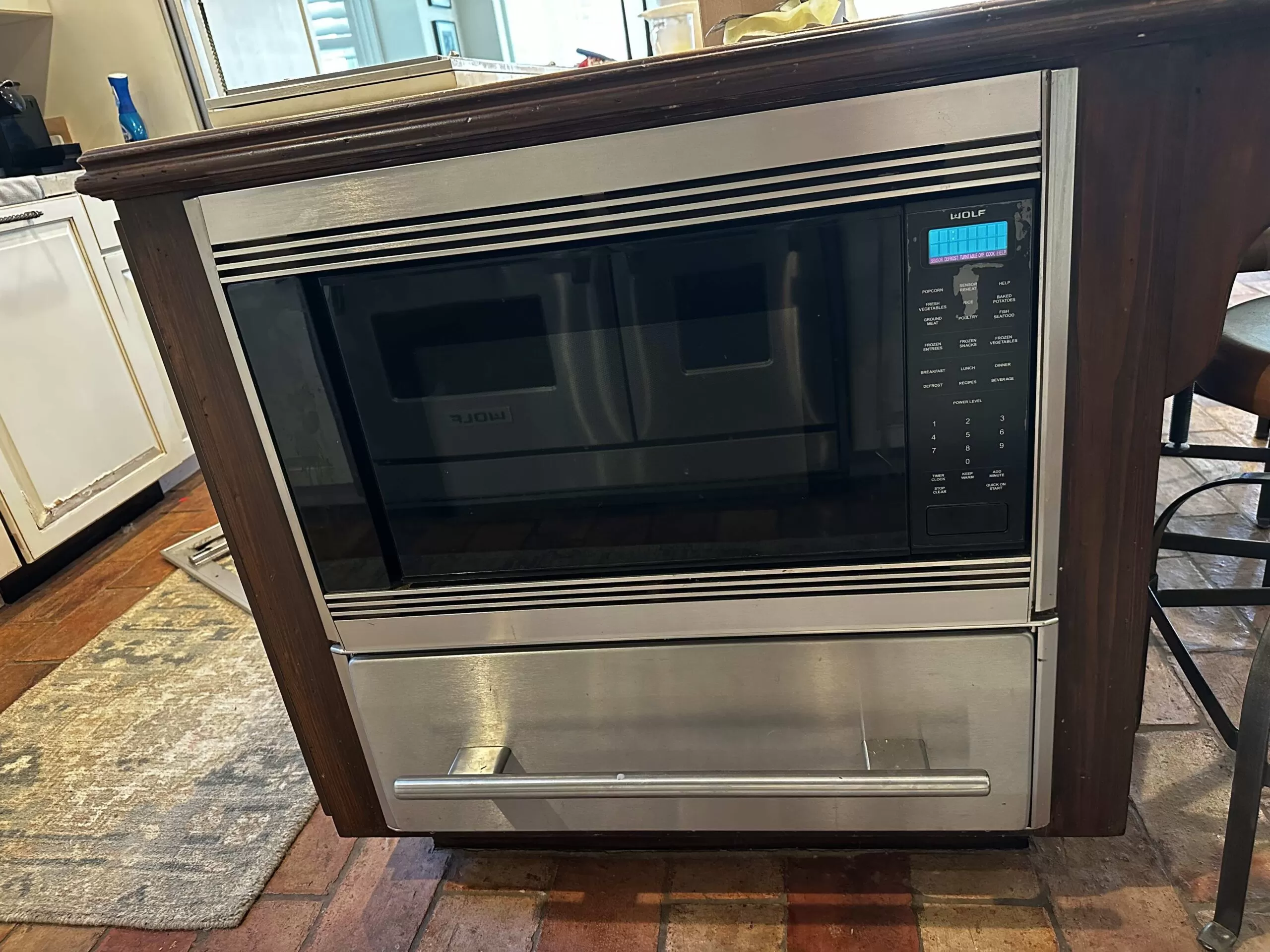
Most appliance faults arrive one at a time. This call brought two: a built-in Wolf microwave in Ponte Vedra Beach whose keypad had gone dark — and which, on the rare occasions the panel flickered back to life, would run a full cycle without warming anything. A double failure changes the whole shape of a repair visit, because you can't diagnose the second fault until the first one is out of the way.
It's also the situation where owners most often assume the appliance is done for. In a built-in kitchen, that assumption gets expensive fast, which is why this case is worth walking through: it shows how methodical microwave repair handles stacked problems, and why the order of operations matters as much as the parts.
The service call
The homeowners, in a Marsh Landing kitchen where the Wolf microwave sat flush in a wall of custom cabinetry, described a strange progression. After a weekend of heavy summer storms, the control panel stopped responding — no display, no beep, nothing. Over the next few days it occasionally woke up, accepted a cook time, and ran; but the food came out cold every time. They'd already checked the breaker and tried unplugging the unit overnight. Two symptoms, one appliance, and a strong hint in the timing: the trouble began with the storms.
Diagnosis on site
Dmitrii's rule for stacked faults is simple: prove the controls first, because a microwave that won't reliably take commands can't be tested for anything else. The power path checked out — outlet live, cord sound, internal line fuse intact, door-switch chain closing correctly. That last check matters because a single worn interlock switch can imitate a dead panel convincingly, and it's a far smaller fix. Not this time: the control panel assembly itself had failed, with the surge-stressed board behind the keypad delivering intermittent power to the display — the classic aftermath of a voltage spike arriving through the line.
With a working panel temporarily proving the control side, the no-heat half got its turn. This half lives in the high-voltage section, and it began the way it always must: discharging the capacitor. That component holds several thousand volts and does not surrender them just because the plug came out of the wall days ago — the single fact that makes microwave interiors off-limits to even confident DIYers. Tested as a set, the trio told a clear story: capacitor healthy, diode healthy, magnetron filament open. The same storm weekend had claimed two victims — the board took the spike, and the magnetron, likely already aging, failed alongside it.
The repair
Because the diagnosis was complete before any work began, the homeowners got one written quote covering both faults — not an approval for the panel followed by bad news about the magnetron an hour later. They approved, which waived the $75 diagnostic per standard GDoing terms, and the repair proceeded in the same visit: new control panel assembly, new magnetron, both parts matched to the Wolf's model and serial, with the diode and capacitor left in place on the strength of their test results rather than replaced on superstition.
The last stretch of a built-in repair is the part nobody sees in parts diagrams: sliding the unit back into its cutout without scarring the cabinetry, restoring the vent clearances, aligning the trim to the cabinet line, and confirming the door swings and latches true. A water-load heating test ran to completion — full output, steady display, no flicker. On-site time: right around an hour.
The outcome
Both replacement parts and the labor behind them are covered by the 1-year parts-and-labor warranty, documented on the invoice, so a repeat of either fault inside the year costs the homeowners nothing. The practical postscript: they asked what would keep this from happening again, and the honest answer is that surge exposure is a house-level problem — a whole-home protector at the panel guards every board in the kitchen at once, and it's a conversation worth having with an electrician in our part of Florida. The microwave has run without complaint since.
What this means for your microwave
- Storm-timed failures deserve a full-chain test. Surges rarely hit just one component; a unit that "mostly works" after a storm may be carrying hidden damage — the erratic behaviors covered in our power-and-glitches guide often trace back to one.
- A dead panel isn't always the panel. Door switches and fuses imitate it; the inexpensive suspects get ruled out first. Our control and display troubleshooting guide shows what you can check from outside.
- Insist on one quote after full diagnosis when symptoms stack — piecemeal approvals hide the real cost of a repair.
- Built-in math favors repair. A replacement has to match a cutout, a trim kit, and a cabinet line; parts and labor usually win comfortably.
- Leave the high-voltage section alone. No screwdriver adventure is worth what that capacitor is holding.
Microwave repair in Ponte Vedra Beach
From Sawgrass to Nocatee's northern edge, Ponte Vedra kitchens run heavily to built-in and trim-kit units — exactly the installations where repair pays off. GDoing covers the area with microwave repair in Ponte Vedra six days a week, same-day when availability allows, and 95 percent of our repairs finish on the first visit. Request repair service or call 904-946-9057.
FAQ
Can one power surge really break two parts at once?
Yes. A spike propagates through the whole appliance in a fraction of a second, and the control board and high-voltage circuit are both in its path. That's why post-storm diagnosis tests the full chain instead of stopping at the first confirmed fault.
Why replace the magnetron but not the diode and capacitor?
Because they tested healthy. Those three components fail together often enough that they must be tested together — but replacing good parts "while we're in there" pads the bill without adding reliability. Measurements, not assumptions, decide what gets swapped.
Is a premium built-in microwave worth repairing at all?
Almost always. Units like this Wolf are built on serviceable platforms with available parts, and the true cost of replacing a built-in includes cabinetry fit, trim, and installation — not just the box. A written quote after diagnosis lets you compare honestly.