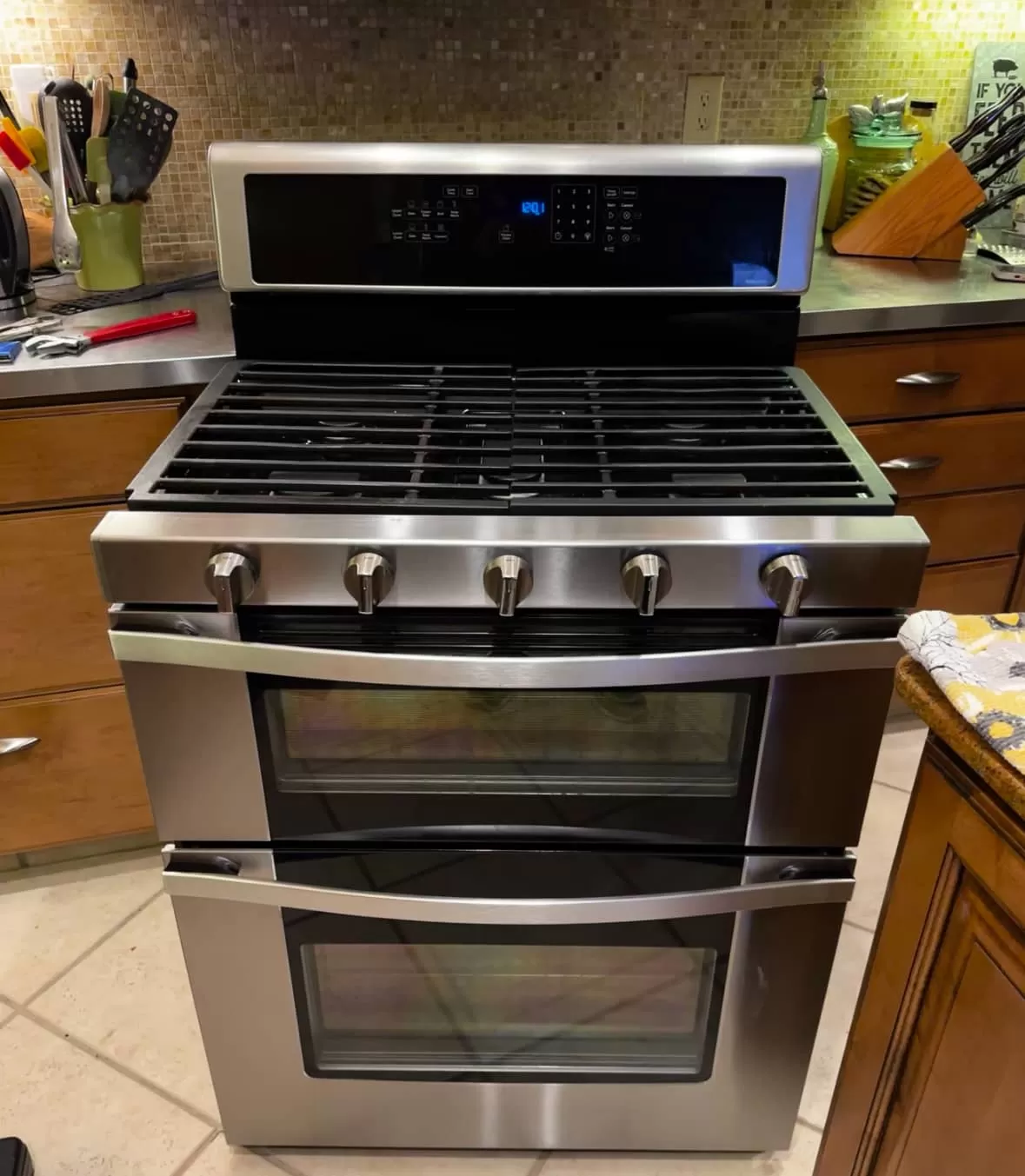
A homeowner in St. Augustine reached out about a Whirlpool gas range with a puzzling split personality: the bake burner worked perfectly, but the broiler had gone dead. Its igniter still glowed on command — they could see it — yet no flame ever followed.
Anything involving the gas path gets treated as a safety job first and a convenience job second, so this case is written the way it was worked: methodically, with a meter, and with a leak test before anyone called it done.
The service call
The homeowner's description did half the diagnostic work. Broil produced a glow but no fire, bake behaved normally, and there was no gas odor at any point — they had checked, and they had stopped using the broiler entirely until someone could look at it. Both decisions were exactly right.
A burner that glows without lighting is one of the two or three most common calls in professional oven repair, and it always comes down to the same pair of suspects. The trick is that they impersonate one another, and swapping the wrong one wastes both money and a week of waiting.
Diagnosis on site
Dmitrii started on the electrical side, because more gas valves get condemned needlessly than almost any other appliance part. The broil igniter's current draw was measured during a call for heat — and it passed, pulling within the manufacturer's specification. A healthy igniter drawing full current means the valve is receiving its signal to open. The next measurement confirmed voltage arriving at the valve coil. Signal present, valve silent: the broiler side of the range's dual safety valve had worn out internally and was no longer opening.
The bake burner kept working through all of this because each burner draws through its own section of the valve — one side wearing out says nothing about the other, which is why half-dead behavior is such a common shape for this fault.
One design note took the worry out of the room. Appliance gas valves are engineered to fail closed, not open — when they wear out, the result is a burner with no fuel, not a kitchen with too much. That is deliberate, and it is why this failure announced itself as a cold broiler rather than anything more alarming.
The repair
The range's supply was shut off and the line verified before anything came apart. The old dual valve was removed, and the replacement was seated with fresh thread sealant on every fitting. Then the step that separates gas work from ordinary repair: each joint was leak-tested with solution, watched for bubbling under pressure, before the appliance was allowed to run.
With the system tight, both bake and broil ran full observed cycles. The broiler lit promptly, the flame held a steady blue with no yellow tips or soot, and the bake side was re-verified to confirm nothing had been disturbed. Because plenty of St. Augustine housing runs gas appliances on lines older than the appliances themselves, the flex connector and the shutoff behind the range were inspected as well — a few extra minutes that are always worth spending on an older installation.
The outcome
The broiler went back into regular use that evening, and the homeowner got a short flame-color primer before the van left: steady blue means health, persistent yellow means call. They also knew where the range's shutoff lived by the end of the visit, which is knowledge every gas kitchen should hold before it is ever needed. The valve and the labor behind it are covered by our 1-year parts and labor warranty, which on gas work covers not just the component but the leak-tested installation around it.
What this means for your range
What this job teaches beyond one broiler:
- Igniter-versus-valve is settled by measurement, not by looking. A glow proves nothing either way; the current reading and the coil voltage tell the real story in minutes.
- The same symptom has an opposite twin. When the igniter is the weak link instead, the fix looks like this igniter replacement case from Palm Coast — same complaint, different verdict.
- Gas valves failing closed is good engineering, not luck. Treat a dead burner as an inconvenience, but never treat the gas path as a DIY project.
- Electronics can fake burner trouble too. Erratic controls sometimes mimic ignition faults — our oven control panel case from Jacksonville shows that side of the family.
- Any strong gas smell changes the rules instantly. Shut the supply if you can reach it, open windows, leave the range alone, and phone from outside.
Oven repair in St. Augustine
Gas range and oven work across St. Augustine — from the historic district out to the newer neighborhoods — is core territory for us, and most valve and igniter jobs finish in a single visit. If you approve the work, the $75 diagnostic comes off completely, and same-day scheduling is often possible in town. Send a repair request or call 904-946-9057.
FAQ
Should I smell gas when a valve fails?
Usually not. These valves are built to fail shut, so the typical symptom is a burner without fuel. If you do smell gas at any point, that is a different situation entirely: ventilate, stop using the appliance, and get a professional out promptly.
Why replace the valve instead of cleaning or rebuilding it?
A safety valve is a sealed component, and its whole job is to be trustworthy. Field rebuilds have no place in the gas path — replacement with a new, leak-tested part is the only version of this repair worth standing behind.
Does a new gas valve need special testing?
Yes, and it is not optional: every disturbed joint gets solution-tested for leaks under pressure, then the appliance runs full observed cycles so the flame quality itself confirms the installation.