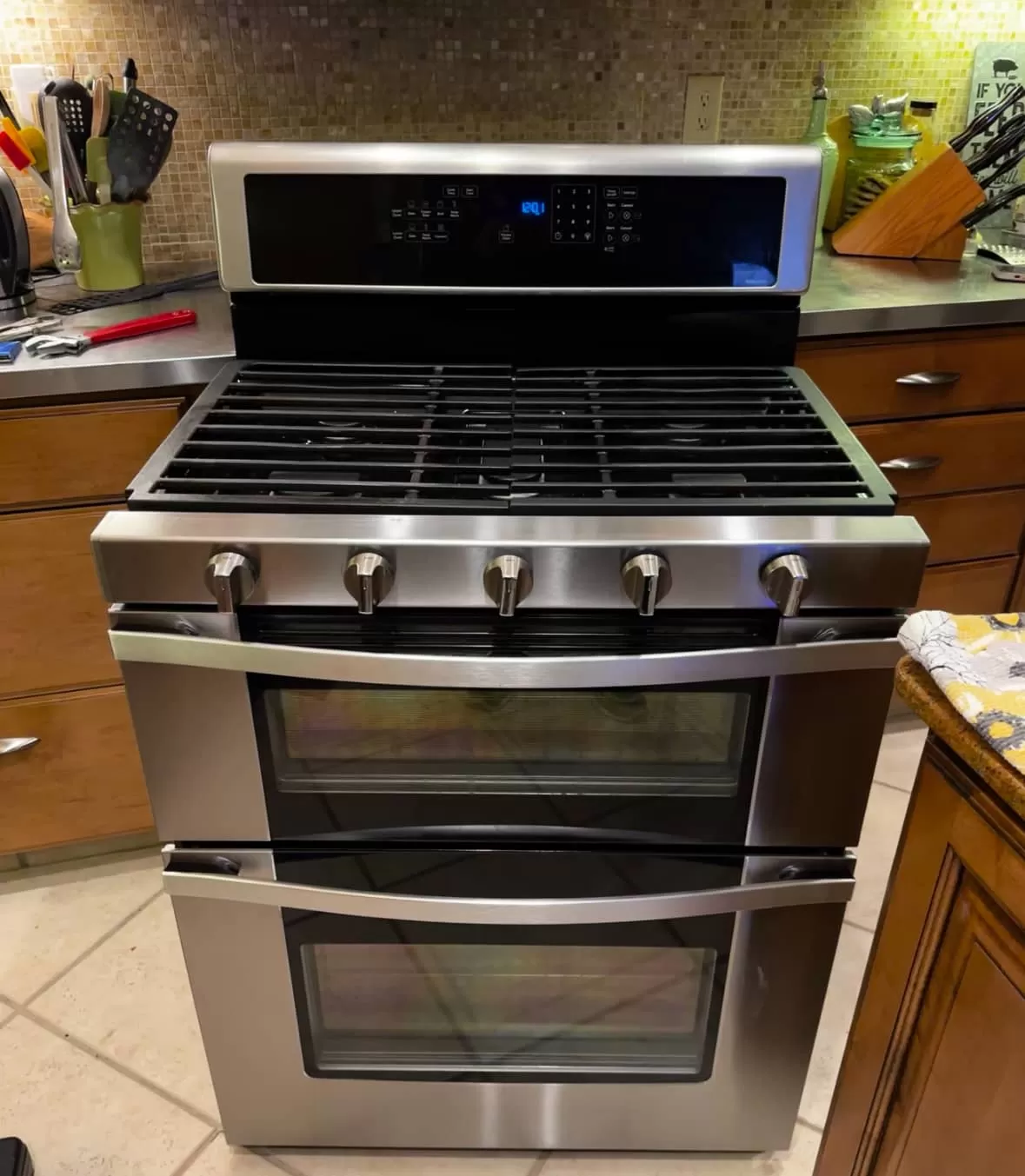
A homeowner in Palm Coast called about a Whirlpool gas oven that had stopped heating altogether. The display worked, the controls answered, the cooktop burners lit normally — but the oven cavity stayed at room temperature no matter what was asked of it.
Gas ovens fail politely more often than dramatically, and this case shows the most common version of that story: a worn igniter. It also shows why the diagnosis is made with a meter rather than judged by eye, and why gas work ends with an observed flame instead of a handshake.
The service call
The report was specific, which always helps. Bake and broil were both dead, there was no smell of gas lingering in the kitchen, and the cooktop still worked — so gas was clearly reaching the appliance. The homeowner had sensibly stopped retrying the oven after the first few attempts rather than letting it click away, which is exactly the right instinct when any gas appliance behaves strangely.
Because the symptom sat squarely in gas oven repair territory, the van carried the common Whirlpool igniter formats out to Palm Coast, and the visit went on the same day's route.
Diagnosis on site
With the oven commanded to heat, the igniter glowed a dull orange, visible through the bottom vents, yet the burner never caught. That single observation narrows the fault to two suspects: an igniter too weak to do its job, or a gas safety valve refusing to open. The two imitate each other well, and the tiebreaker is electrical, not visual.
Dmitrii measured the igniter's current draw while it called for heat. It came in below the manufacturer's specification, which settles the question: on this design, the safety valve opens only once the igniter draws enough current to prove it is hot enough to light gas instantly. A weak igniter keeps a healthy valve closed — a deliberate safety arrangement, and the reason the oven stayed cold instead of filling with unburned fuel. Up close, the element also showed hairline cracking, the usual signature of age.
The repair
Gas work follows a fixed order. The oven's supply was shut, power was disconnected, and the bottom panel and rack supports came out to expose the burner assembly. The old igniter was unbolted and its connector separated; the harness behind it checked out intact. The replacement — the correct format for this model, since Whirlpool uses both flat and round elements across its lineup — went in with a light touch, because a new igniter is every bit as brittle as the one it replaces.
Then came the part that makes it a finished job rather than a parts swap: gas and power restored, a full preheat observed from ignition to set temperature, the flame checked for a prompt catch and steady blue color, and the burner watched through a complete cycle. The oven hit temperature on the first test.
The outcome
Total time on site was under an hour once the diagnosis was confirmed, and the homeowner baked that same evening. The igniter and the labor are covered by our 1-year parts and labor warranty. We also left one piece of advice worth repeating: when a gas oven will not light, stop commanding it to try. Every failed attempt adds wear and briefly meters gas to a burner that cannot light it.
What this means for your oven
The transferable lessons from this call:
- Slow preheat is the early warning. Igniters fade gradually, so an oven that takes longer every month is telling you the element is weakening.
- A glowing igniter is not a healthy igniter. Brightness cannot be judged by eye; only the current draw against specification says whether it can open the valve.
- A brief gas smell at light-up that ends with no flame means book a visit now, not eventually — that is the weak-igniter pattern at its riskiest.
- When the igniter tests healthy, suspicion moves to the valve. That opposite verdict is its own story — we wrote up a gas valve replacement case in St. Augustine that shows how it goes.
- Self-clean cycles are hard miles for ignition parts. If your oven already lights slowly, read up on self-cleaning oven risks before running one.
Oven repair in Palm Coast
From Palm Harbor down to Belle Terre, a cold gas oven is usually a one-visit fix when the right igniter formats ride along. The $75 diagnostic is waived when you approve the work, and same-day service is available when the schedule allows. Book through oven repair in Palm Coast, use the request form, or call 904-946-9057.
FAQ
Is it dangerous to keep trying to light a gas oven that will not heat?
Repeated attempts are unwise. The safety valve design prevents major gas release, but each failed cycle adds wear and can let small amounts of gas puff before shutdown. Stop trying — and if you ever smell gas strongly, ventilate and make the call from outside the house.
Why does the igniter glow but the burner never lights?
Glow only proves current is flowing, not that enough is flowing. The valve requires a specific current draw before it opens, so a weakened igniter can shine convincingly while holding the whole system shut.
Can I replace an oven igniter myself?
Mechanically it is a simple part, but it sits in the gas path, and the job is only done once the flame pattern and a full cycle have been observed with everything reassembled tight. We recommend leaving gas-side work to a technician; the warranty then covers both the part and the workmanship.