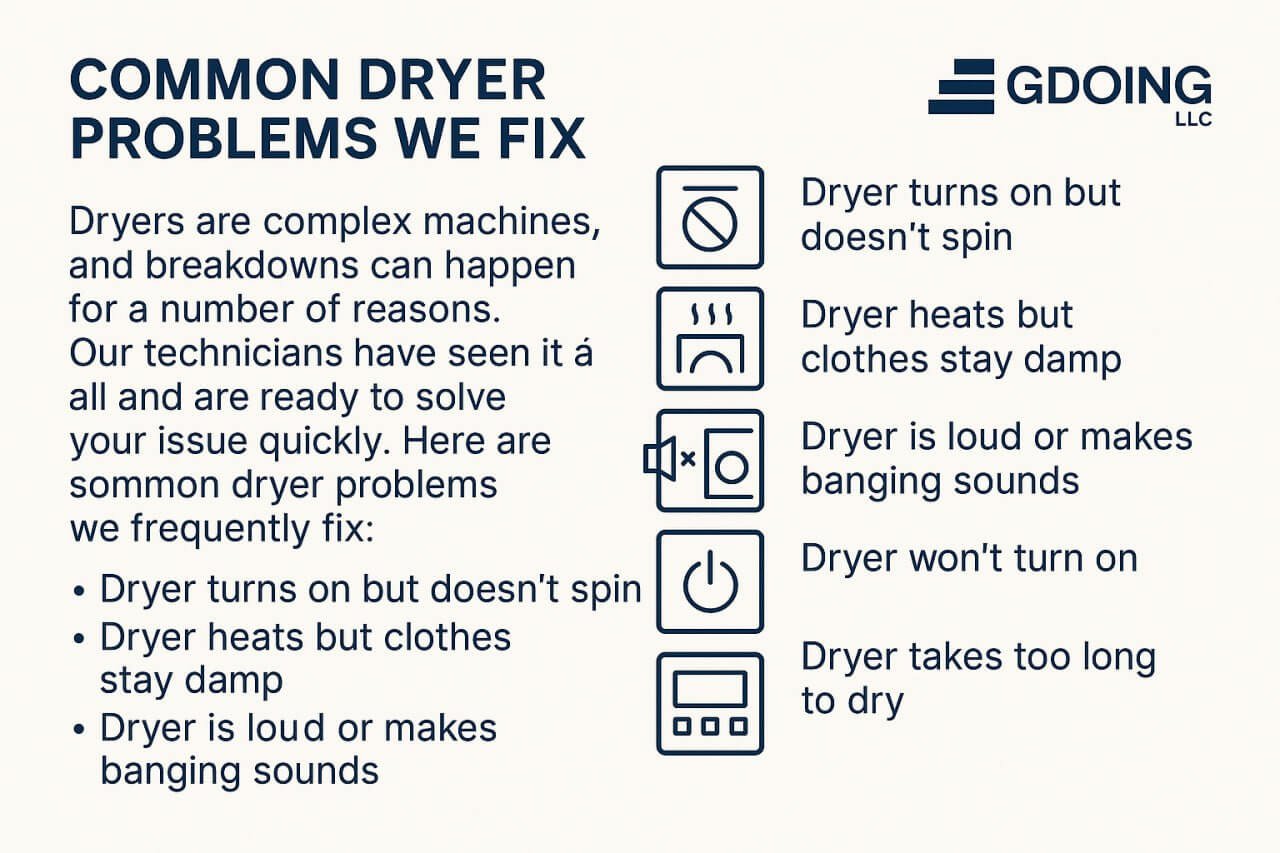
Your dryer powers on, the lights are working, maybe you even hear a gentle hum - but the drum just won’t spin. Sound familiar?
If your laundry is still wet after a cycle because your dryer isn’t tumbling, you’re not alone. This is one of the most frustrating - but fixable - dryer issues we see at GDoing Appliance Repair. The good news? With the right diagnosis, it’s often an easy repair.
Let’s break down what might be causing this and how our technicians can help.
What Causes a Dryer to Stop Spinning?
Several parts work together to rotate the drum inside your dryer. If any one of them fails, the drum can stop moving - even if the dryer still powers on.
Here are some of the most common reasons:
- Broken Drive Belt
Over time, the belt that spins your dryer’s drum can wear out or snap entirely. When this happens, the motor might still hum, but the drum stays still.
- Faulty Drum Rollers or Bearings
If the rollers or bearings that support the drum seize up, the motor may not be able to turn the drum - or may shut down to prevent damage.
- Malfunctioning Door Switch
If your dryer “thinks” the door is open, it won’t spin for safety reasons - even if it’s receiving power.
- Burnt-Out Motor
In some cases, the motor itself may be the issue. It may hum without being able to generate enough force to turn the drum.
- Defective Idler Pulley
The idler pulley keeps the drive belt tensioned correctly. If it breaks or gets stuck, the belt can slip and prevent drum movement.
If your dryer turns on but the drum refuses to spin, don’t wait for the problem to get worse - it’s often a fixable issue that just needs a professional touch. At GDoing Appliance Repair, our certified technicians are ready to diagnose the cause and get your dryer back to working like new. We service all major brands and offer same-day appointments across Jacksonville, Palm Coast, and Saint Augustine.
Meet the parts behind the noise
Many of these same parts also make noise as they wear, so the sounds below can warn you before the drum stops turning.
Drum support rollers
The drum's weight rides on small rubber-treaded wheels — typically two at the rear, sometimes two more up front. As the tread hardens and develops flat spots, you get rhythmic thumping in time with the drum; let a roller seize entirely and it grows into a heavy rumble you can feel in the floor. Because the wear is gradual, the noise seems to have crept up on you. Rollers get replaced as a set, and doing it early spares the belt and the drum surface.
The idler pulley
A spring-loaded arm keeps the belt tensioned, pivoting on a small wheel that spins the entire time the dryer runs. When its bearing dries out, you hear squealing or rapid squeaking — often loudest at startup, sometimes fading as things warm. An idler at the chattering stage is living on borrowed time; when it finally seizes, it burns or throws the belt.
The drive belt
One long, thin belt wraps the entire drum. With age it frays and delaminates, and the damaged patch slaps the housing once per revolution — a tick, tick, tick that tracks drum speed. When a belt gives up completely, the noise stops and so does the tumbling — the drum no longer turns while the motor keeps running, which is exactly the problem at the top of this page.
The blower wheel
The fan pushing air out the vent is usually plastic and lives in the dirtiest spot in the machine. Cracked blades, a hub loose on its shaft, or a housing packed with lint chunks produce a roar or harsh rattle from the lower rear of the cabinet. A compromised blower also moves less air, which invites overheating — so a dryer that got loud and then began quitting early may have one fault, not two. Our post on a dryer that shuts off too soon picks up that half of the story.
Drum glides, seals, and bearings
The drum's front edge rides on plastic glides or a felt seal, and some designs add a rear bearing. When these surfaces wear through, metal meets metal: a scraping or grinding right at the drum's rim, occasionally leaving brown scuff marks on light-colored clothes. Scraping earns an immediate stop — every rotation is machining a groove into the drum.
Stowaways: the noise that isn't wear at all
Coins, screws, and zipper pulls clatter around the drum; an underwire or hairpin can slip through the drum's perforations into the blower housing, where it scrapes like a card in bicycle spokes. A clank that arrived with one particular load isn't a failing part — it's cargo. Check pockets first, then look and listen around the drum baffles, where small objects love to lodge.
Narrowing it down at home
- Cut power at the plug before hand-turning the drum or reaching into the lint slot. Treat a gas dryer's supply line as untouchable — don't drag or tilt the machine against it, and if you smell gas, call the utility rather than any repair number.
- Run the dryer empty for two minutes. If the sound vanishes, it was the load — think buckles, pocket change, or shoes.
- Rotate the drum slowly by hand and feel for catches, rough patches, or a rub at the rim.
- Remove the lint screen and shine a flashlight down its slot; stray items and lint mats collect right at the blower's doorstep.
- Press lightly on the drum front while turning it: a scrape that changes with pressure implicates the glides or seal.
- Time the rhythm. Once per revolution says belt or a drum flaw; constant says idler, rollers, or blower; only-under-load says support parts giving way beneath weight.
- Jot down what you heard and when it happens — a ten-second description helps a technician more than a ten-minute video.
Sounds that mean switch it off now
Three noises justify an immediate stop. Metal-on-metal grinding means drum damage is in progress. A squeal paired with a hot or scorched smell means the belt is dragging over a seized pulley — friction heat inside a lint-lined cabinet is nothing to gamble with. And violent banging that shakes the whole machine means a support has failed and the drum is loose. Unplug it, then call 904-946-9057 and describe the sound; we'll tell you honestly whether it can wait for the next opening.
Sand and salt find their way into dryers here
Beach living is hard on drum hardware. Sand rides home in towels and swimsuits, sifts through the drum's holes, and embeds itself in roller treads and glides, where it works like fine grinding paste. Meanwhile, in garage installations, humid coastal air corrodes roller shafts and the idler pivot — true along the river in Green Cove Springs just as much as out on the sand at Vilano. The habits that help: shake beach gear out before it comes inside, brush grit away from the door seal area, and wipe down the drum after a beach-heavy weekend.
What GDoing does about a loud dryer
Describe the sound when you book — thump, squeal, roar, clank — and the technician arrives with a shortlist already in mind, because dryer wear parts are well-mapped territory; noise calls sit squarely inside our 95% first-visit fix rate. Your $75 diagnostic is waived when the repair gets your approval, and parts and labor carry a one-year warranty. Same-day slots are offered when the calendar permits. Book a repair visit and we'll bring the quiet back.
Signs Your Dryer Needs Professional Help
Not every spinning issue is easy to diagnose without opening the unit. Here are signs it’s time to call GDoing:
- Dryer hums but drum doesn’t rotate
- Burning rubber or electrical smell
- Clicking sounds or buzzing noises
- You replaced the belt but it still doesn’t spin
- Dryer stops mid-cycle or doesn’t start spinning at all
If you’re noticing any of these warning signs, it’s best not to ignore them - continuing to run a malfunctioning dryer can lead to bigger (and more expensive) problems down the line. Trust the experts at GDoing Appliance Repair to accurately diagnose the issue and provide a lasting solution. We’re just a call or click away, ready to restore your dryer’s performance with fast, professional service.
Why You Shouldn’t Wait to Repair a Non-Spinning Dryer
Running your dryer in this state can overheat the motor, damage internal parts, or waste energy trying to complete a drying cycle that’s not happening. Delaying service often leads to costlier repairs later.
Our Fix-It-Right Approach
At GDoing Appliance Repair, we go beyond just swapping parts. We diagnose the actual cause of the failure and fix it right - the first time.
Here’s how we handle non-spinning dryer issues:
- Full Drum Inspection – We check belts, pulleys, rollers, and bearings to pinpoint what’s jammed or broken.
- Motor Testing – Our techs test motor functionality and current draw to determine if it needs replacement.
- Safety Switch Evaluation – We test and replace faulty door switches that may prevent spinning.
- Only Original Parts – We only use manufacturer-approved parts to ensure durability and performance.
- Same-Day Repair – In most cases, we can complete repairs on the same day with parts on hand.
Why GDoing Appliance Repair?
When it comes to dryer repairs, you want a service you can trust to get the job done right — and fast. At GDoing Appliance Repair, we’ve built our reputation on reliability, expertise, and a commitment to customer satisfaction. Here’s why homeowners across Jacksonville and surrounding areas consistently choose us for their appliance repair needs:
- Certified Dryer Specialists
From Whirlpool to Samsung to LG, we repair gas and electric dryers across all major brands. - 1-Year Warranty on All Repairs
We stand behind our work with a full-year warranty for peace of mind. - Fast & Friendly Service
We’re locally based in Jacksonville, FL and cover Palm Coast, Saint Augustine, and surrounding areas with same-day and next-day availability. - Honest, Transparent Pricing
No surprise fees. Just fair, upfront rates and free estimates.
Don’t Let Laundry Pile Up
Your dryer might just need a belt replacement - or something more complex. Either way, our technicians at GDoing Appliance Repair are ready to help. We’ll restore your dryer’s spin so you can get back to dry, fluffy laundry without the wait.
Call us now or book your repair online for same-day service!
FAQ
Why does my dryer thump only when clothes are inside?
Weight changes everything. Worn rollers and glides can carry an empty drum silently but complain under a wet load. The empty-versus-loaded test is still useful — just remember that quiet-when-empty doesn't fully acquit the support parts.
My dryer squeals for a few minutes, then goes quiet. Fine to ignore?
That warming-up squeal is the classic sound of a dry idler or roller bearing, and it's the early stage. It's easiest to deal with now, before the failing part takes the belt with it.
What's rattling if the drum is empty?
Usually an object that escaped into the blower housing or the base — listen near the lint slot while it runs. Outside, a loose vent flap can also chatter loudly enough to get blamed on the machine itself.
Can a noisy dryer damage clothes?
It can. Worn glides let the drum's metal edge catch fabric, cracked baffles pinch it, and a rough drum seam snags knits. If scuffs, small tears, or brown marks are showing up alongside the noise, the drum hardware is telling on itself.
Related dryer guides: Dryer Takes Too Long to Dry · Dryer Won't Turn On