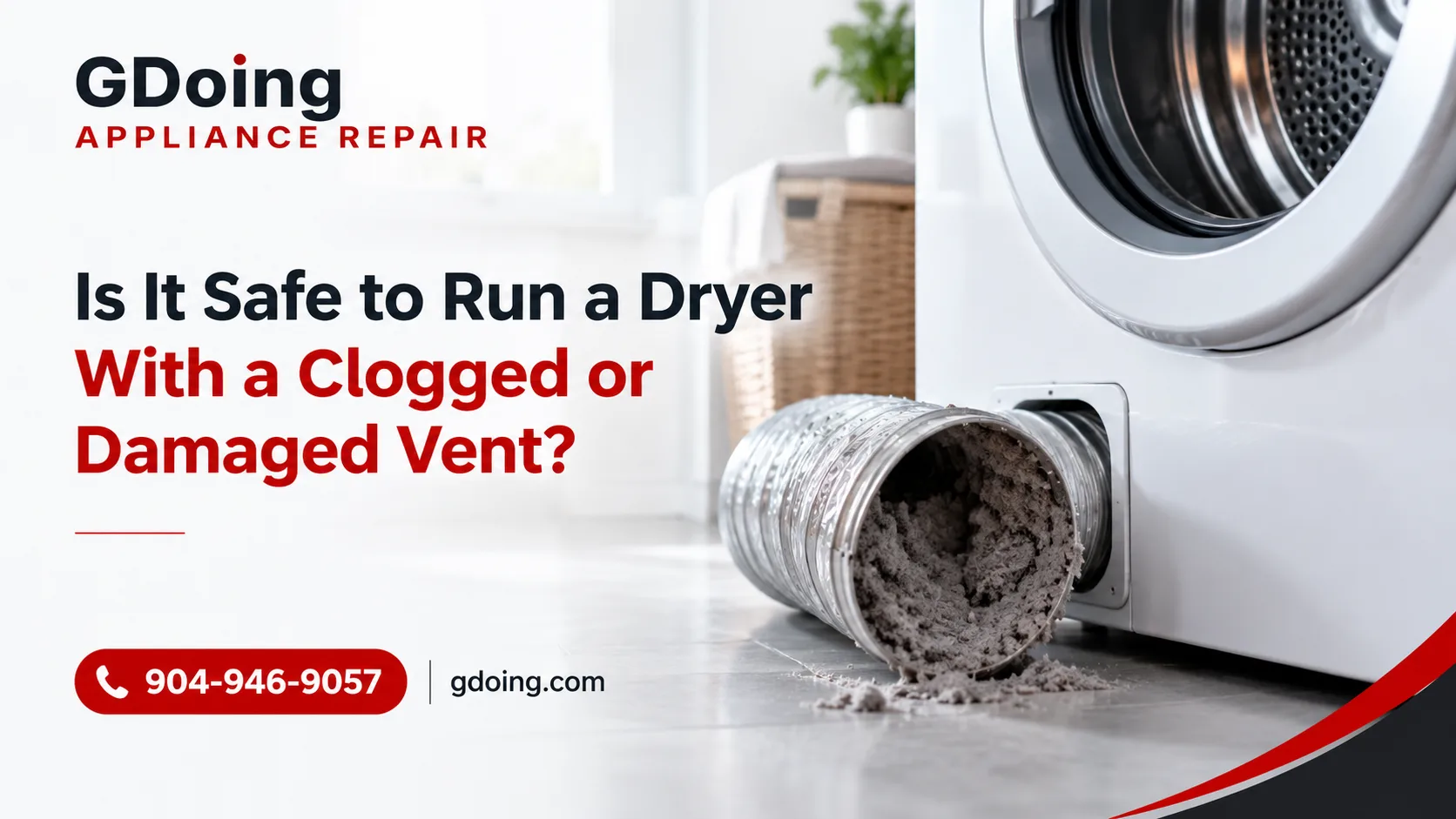
No, it isn't safe. Running your dryer with a clogged dryer vent raises the risk of a house fire, and with a gas dryer it can push carbon monoxide into your home. A damaged vent is just as risky, and it's easy to miss until something goes wrong.
If your clothes need two cycles to dry or your laundry room feels unusually hot, don't just start another load. This guide shows how to spot the problem, what you can check safely yourself, and when it's time to call a technician. Good dryer vent safety starts with knowing what to look for.
Short Answer: When You Should Stop Using Your Dryer
Stop using your dryer and call a technician if you notice any of these:
-
A burning smell coming from the dryer or the vent (if you see smoke or flames, leave the house and call 911)
-
A dryer cabinet or nearby wall that feels hot to the touch
-
No airflow at the outside vent, or an outside flap that stays shut while the dryer runs
-
A crushed, torn, or disconnected vent duct
-
Any smell of gas, or a carbon monoxide alarm going off (leave the house and call 911 or your gas utility)
If none of these apply but your laundry takes longer than usual to dry, you likely have an early-stage clogged dryer vent. Clean the lint filter and check the vent within a few days, before it becomes a hazard.
Why a Clogged Dryer Vent Is More Than a Nuisance
Every load sheds tiny fibers. Your lint filter catches most of them, but not all. The rest travel down the duct and settle on its walls and bends, where hot air keeps drying them out for an hour at a time. Lint is highly combustible, and a narrowed duct traps heat right next to it.
The fire risk is well documented
The National Fire Protection Association (NFPA) reports that U.S. fire departments responded to an estimated 15,970 home fires involving clothes dryers or washing machines each year in 2010–2014, and dryers were involved in about 92% of them (NFPA fact sheet). The leading factor was failure to clean. The U.S. Fire Administration reached a similar conclusion: in its analysis of residential dryer fires in 2008–2010, failure to clean was behind 34% of them, and dust, fiber, and lint were the most common first items to ignite (USFA topical report).
The U.S. Consumer Product Safety Commission says the same thing in plain terms: fires start when lint builds up in the dryer or in the exhaust duct (CPSC dryer safety publication). Built-in thermostats help, but they are a last line of defense, not a reason to keep running a restricted dryer.
Gas dryers add a carbon monoxide risk
A gas dryer burns fuel, so its exhaust carries combustion gases along with heat and moisture. When the vent is restricted, that exhaust can leak back into your home. Technical Safety BC warns that restrictions in the vent may cause dryer exhaust leaks that could contain carbon monoxide (Technical Safety BC, the British Columbia regulator). Carbon monoxide has no smell, so a working CO alarm near the laundry area matters. Electric dryers don't make carbon monoxide, but the fire risk is the same. If you're deciding between the two types, our guide to gas vs. electric dryers in Florida humidity breaks down the safety, energy, and cost differences.
It also costs you money
A restricted vent forces your dryer to run longer and hotter. You pay for it on your energy bill, and the heating element, thermostat, and motor wear out faster. Trapped moisture can also leave a musty smell in your laundry room.
Signs of a Clogged Dryer Vent
Your dryer usually tells you something is wrong long before a fire risk appears. Watch for these warning signs:
-
Long drying times. If a normal load needs two cycles, airflow is likely restricted. Our guide to why a dryer takes too long to dry covers other causes to rule out.
-
Clothes that are hot but still damp. Heat is being produced, but the moist air has nowhere to go.
-
A hot dryer cabinet or a warm wall behind it. Heat that can't leave through the duct builds up around the machine.
-
A burning or musty smell. Scorched lint smells like burnt fabric, and trapped moisture smells stale.
-
Lint around the outside vent, or an outside flap that doesn't open. The flap should lift while the dryer runs.
-
Condensation or excess humidity on laundry-room windows and walls.
A two-minute airflow test
Run the dryer on a no-heat or air-only setting. Go outside and hold your hand near the exhaust opening. You should feel a strong, steady stream of air and see the flap open fully. A weak breeze, a flap that barely moves, or no air at all points to a blockage. Stop using the dryer for heated cycles until the vent has been cleaned.
Any single sign may have another cause, such as an overloaded drum or a failing heating element. Two or more together almost always mean the vent needs attention.
What a Damaged Dryer Vent Looks Like
A damaged dryer vent doesn't always look dramatic. Most damage happens quietly, in the few feet behind the machine or at the outside wall:
-
A crushed or kinked hose. This is the most common problem. Pushing the dryer tight against the wall can fold the duct in half and choke the airflow.
-
Torn foil or plastic duct. Thin, flimsy ducting sags, tears, and collects lint in every fold. Fire-safety guidance, including the NFPA's dryer safety tips, recommends metal venting rather than plastic.
-
Loose or disconnected joints. Hot, humid exhaust then escapes into the wall, ceiling, or crawl space instead of outdoors.
-
A blocked or broken outside cap. Birds and rodents like to nest in vent openings, and snow or debris can cover the flap in winter. The U.S. Fire Administration notes that nesting animals can compromise a vent and lead to overheating (Insurance Journal summary of the USFA report).
The danger is the same as with a clog: restricted airflow, trapped lint, and heat in the wrong place. A leaking vent adds one more problem, which is moisture inside your walls, where it can cause mold and rot you won't see for months. If you spot any of these signs, don't run the dryer until the duct is repaired or replaced.
Dryer Vent Inspection: What You Can Safely Check Yourself
A basic dryer vent inspection takes about 15 minutes and needs no special tools. Here's what to do:
-
Cut the power. Unplug the dryer. If it's a gas model, close the gas shutoff valve too.
-
Pull the dryer out carefully. Move it slowly so you don't crush or disconnect the duct.
-
Look at the duct behind the dryer. Check for kinks, tears, dents, and loose connections at both ends.
-
Check the duct material. Foil or plastic duct should be replaced with metal.
-
Inspect the outside vent. Look for lint, nests, or debris, and make sure the flap moves freely.
-
Clean the lint filter and the filter housing. Wash the screen with warm soapy water if it feels coated. A film of fabric-softener residue can block airflow even when the screen looks clean.
-
Run the airflow test from the previous section once everything is reconnected.
Where to stop. Don't open the gas connection, don't take apart the dryer's internal vent path, and don't push tools deep into ducts that run through walls or up to the roof. If the duct is long, has several turns, or the dryer is gas-powered and something looks wrong, leave it to a technician.
How often should you inspect?
-
Lint filter: after every load
-
Outside vent and flap: every two to three months, and after storms or snow
-
Full duct inspection and cleaning: at least once a year, more often for large households or heavy laundry loads
Dryer Vent Maintenance: Habits That Prevent Most Problems
Good dryer vent maintenance is mostly about small routines. These habits, in line with the NFPA's dryer safety tips, keep lint from building up in the first place:
-
Never run the dryer without a lint filter, and replace one that is torn or warped.
-
Don't overload the drum. Clothes need room to tumble so air can move through them.
-
Keep the space around the dryer clear. Boxes, cleaning supplies, and piles of laundry shouldn't sit next to it.
-
Don't dry items that have touched flammable substances, such as gasoline, paint thinner, or cooking oil. The NFPA says never to dry items that have come in contact with flammable substances.
-
Skip foam, rubber, and plastic items. The USFA notes that foam-backed rugs and athletic shoes can reduce airflow in a dryer.
-
Turn the dryer off when you leave the house or go to bed.
-
Check the outside flap in winter to make sure snow or ice isn't covering it.
-
Book a professional cleaning once a year. Even careful households miss lint deep in the duct.
Can You Run One More Load? A Quick Decision Guide
Use this table when you're not sure whether to keep using your dryer.
|
What you notice |
Is it safe to keep using it? |
What to do |
|
Loads take longer than usual, nothing else seems off |
Short term only, with a cleaned filter |
Clean the filter, run the airflow test, and schedule a vent cleaning this week |
|
Dryer cabinet or nearby wall is hot |
No |
Turn it off and call a technician |
|
Burning smell or visible smoke |
No |
Turn it off, unplug it, and call a technician. If there's smoke or flames, leave and call 911 |
|
Crushed, torn, or disconnected duct |
No |
Stop using it until the duct is repaired or replaced |
|
No air at the outside vent |
No |
Check the flap for blockage, then call a technician if airflow doesn't return |
|
Gas dryer with a gas smell or a CO alarm sounding |
No |
Leave the house immediately and call 911 or your gas utility |
When to Call a Professional
DIY checks are a good start, but some situations need a technician:
-
Your duct is long, has several bends, or runs through a wall, ceiling, or roof
-
You own a gas dryer and suspect a leak, a poor burn, or a blocked exhaust
-
The airflow test still fails after you've cleaned the lint filter and the outside vent
-
The dryer is overheating or shutting off mid-cycle
-
You can see damage but can't tell how far it goes
A professional dryer vent inspection measures airflow, checks every joint and bend, and finds problems you can't see from behind the machine. It also looks at the dryer itself, because a weak heating element, a faulty thermostat, or a worn belt can cause symptoms that look like a vent problem. If your dryer powers on but the drum won't turn, that's a different issue with its own causes, which we cover in why a dryer turns on but doesn't spin.
At GDoing, our technicians diagnose the whole system, from the lint trap to the outside cap. We use original parts, back our repairs with a warranty, and offer same-day service so you're not stuck with a hazard for days. Learn more about our dryer repair service, or if you're local, see our appliance repair in Jacksonville.
Don't Ignore the Warning Signs
A clogged or damaged vent turns an everyday appliance into a hazard. The good news is that the warning signs are easy to spot, and a yearly check keeps most problems from ever starting. If your dryer is slow, hot, or smells off, don't wait for it to get worse. Book a same-day dryer vent inspection with GDoing and get it checked before your next load.
FAQ
Can a clogged dryer vent cause a fire?
Yes. Lint that builds up in the duct is fuel, and restricted airflow lets heat build up around it. Failure to clean is the leading factor in home dryer fires, according to the NFPA and the USFA.
How often should I schedule a dryer vent inspection?
At least once a year. Do it more often if you have a large household, a long or complicated duct run, pets, or you do laundry daily.
Is a damaged dryer vent dangerous for a gas dryer?
It can be. A damaged or blocked vent may let combustion exhaust, which can contain carbon monoxide, leak back into your home. Keep a working CO alarm near your laundry area.
Can I use a plastic or foil vent hose?
It's best not to. Thin plastic and foil ducts sag, tear, and trap lint, and they don't hold up in a fire. Metal duct is the safer choice.
How long should a dryer cycle take?
Most normal loads should dry in roughly an hour or less. If yours regularly needs two cycles, check the lint filter and the vent, or read our guide to why a dryer takes too long to dry.
Does cleaning the lint filter replace vent cleaning?
No. The filter catches most lint, but fine fibers still reach the duct. You need both.